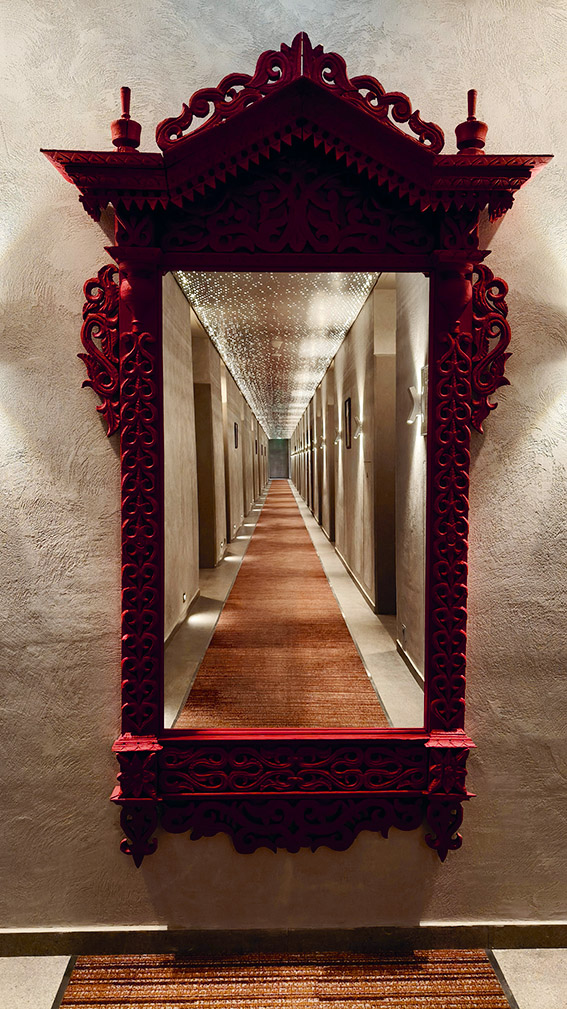
Every year since 2018, the Tryn*Trava. Modern Russian Style exhibition has brought together artists, sculptors, designers, decorators, ceramists, textile specialists, and representatives of various decorative industries to reflect collectively on what constitutes Russianness in design, décor, and interiors. Named after a magical plant that is difficult to find but endows its finder with strength and courage, Tryn*Trava cultivates an interactive field where those working on the theme of Russian style connect with connoisseurs and collectors, fostering a love for Russian culture, traditions, customs, and history among broader audiences.
We have discussed themes organically emerging at the exhibition, regional agenda enhancement, and effective work within a triumvirate with organizers, curators, and designers Elina Tuktamisheva, Irina Batkova, and Svetlana Popova.

One key visual image of the 2025 exhibition was an ear of grain. This wasn’t a response to a topic set for participants but happened unexpectedly. The image of the ear of grain appeared spontaneously in many submitted works. It’s worth asking how this idea has grown over the eight years from different perspectives, both as an event-project with a store and as a space of meanings.
S.P.: The emergence of the ear of grain as the main image is another case when coincidences are not random. Over the eight years of observation, we have repeatedly seen how creators receive ideas that form the topics each year. Globally, our theme remains constant: modern Russian style. Yet creators do not live in a vacuum, rather they act like sensitive conductors. What floats in the air, be it a question, statement, or experience, takes shape. Even though they don’t know one another, they choose the most fitting meanings shared by all. Once again confirming that both Russian style and the Tryn*Trava exhibition serve as unifying platforms, with common meanings for everyone.

E.T.: During the pandemic years, we witnessed angels descending on people: something invisible protected us against another invisible force. And these angels have never left us; they’re still with us today. Then we observed how the world took the form of a primordial egg: we received a large number of such forms in applications. Ultimately, during the exhibition, we reflected on what new world would emerge. In subsequent years, there were numerous statements about words, their importance, and value. A demand arose for Russian style among wider audiences who looked deeper within themselves and their culture, seeking support and important meanings. Creators communicated with people through words, embodying meanings.
In 2025, the leitmotif was the ear of grain, along with millstones and dough, what had been sown sprouted and borne fruit, leading to creation. We’re currently observing growth and seeing the process unfold but only next year will we understand what it will turn into.
How have your relationships and connections with the Russian museum community developed over these years? Museums traditionally undervalue applied arts and design.
I.B.: Federal museums are part of our project’s history: in different years, Tryn*Trava has been held at the All-Russian Decorative Art Museum, the Fashion and Design Centre at the All-Russian Decorative Art Museum, and ROSIZO exhibition halls. After the COVID-time exhibition at ROSIZO, which was forced to close owing to restrictions on mass events just two days after opening, we began considering alternative venues. Unfortunately, even now, the project lacks its own space. Visitors often ask if they could visit the exhibition and shop throughout the year. Currently, we’re very happy collaborating with Muravyovs–Apostols Museum–Estate: for the last four years, Tryn*Trava is held there every October. Setting up a pop-up store with items participating in the exhibition helps us recognize the significance of sales for both creators and visitors alike.

S.P.: At some point, professional communities raised acute classification questions: what exactly is design? Where does decorative-applied art stand? Can it be considered high art? Whom should we call designers and whom artists? Responding to these queries, we introduced the term “creator” because, as practicing designers, artists, and curators, we’ve noticed there’s a scale along which someone working with materials and meanings might shift, depending on the task. If production doesn’t require industrial design, no industrial design emerges. Yet, if it is needed, artist Malevich begins designing perfume bottles. Our annual exhibition showcases creations made specifically for our event. Here, beyond creators’ meanings and aspirations, you also see manufacturing process states and whether requests exist for Russian style objects.
The cultural code is far more than abstract, it’s catchy. Marketers love using it, while art historians, culturologists, and sociologists approach it cautiously. The Russian cultural code encompasses too much: folk craft and the archaic (from which early 20th century Russian avant-garde emerged); the avant-garde itself (notably, Russia presented itself globally via this genre at the Sochi Olympics opening ceremony); Soviet heritage; local regional identities reflecting vast territories and diverse terroirs. What predominates at your exhibition? Which aspects most interest contemporary designers? Over Tryn*Trava’s eight-year existence, have you noted any changes in the dynamics of what predominates in reflecting the national identity?
I.B.: Internally, we cherish the “cultural code” concept because, for us, it’s alive and comprehensible. Previous generations’ experiences influence on us has been scientifically proven, become literally encoded in our DNA. Just as we instinctively react to rustling grass as a signal of potential danger, we aesthetically sense beauty, rightness in terms of creativity, or wrongness in interpretations of destructive or dangerous elements. Similarly, cultural codes can be viewed as clouds of tags without time constraints, containing accumulated generational memory. The more cloud-tags you possess as a person of your own era, the more profoundly you’ll touch or decode them, understanding their embedded meanings. As long as civilization carries this knowledge-cloud, these tags remain useful. So, cultural code does, indeed, prove practical.
E.T.: Over the eight years, we’ve observed how creators can draw inspiration from any period or stylistic pattern on the basis of their expression needs. The goal isn’t to reprocess pre-existing imagery but to create unique expressions rooted in ancestry that characterize our current time, the here and now. We’re not playing historical games.
Regarding shifts in dominance, this year, regions demonstrated search independence, ceasing to orientate themselves on capital cities, producing objects grounded in their regional cultural codes. This proved particularly resonating and intriguing, attracting even Moscow-based collectors.

In addition to invoking various associations, the name of the exhibition symbolizes unity. Having three heads recalls Zmey-Gorynych, Vasnetsov’s Three Bogatyrs representing a version of Russian national artistic identity, Troika bird by Gogol, Chekhov’s Three Sisters. How do you divide responsibilities internally?
S.P.: It’s also akin to “the height of heaven, breadth of earth, depth of sea” trinity. If the exhibition represents Essence, we are Hypostases. This allows us to view subjects and meanings from a full 360° perspective. Maintaining internal harmony, we make decisions collaboratively and effectively cover for each other, which is beneficial for the project. Importantly, friendship didn’t give birth to the exhibition but rather friendship blossomed through joint efforts. Each of us brought her previous experience, deep study of and passion for culture. Naturally, sometimes our views diverge, yet we follow one rule: if one curator appreciates an object enough to envision it at the exhibition, we include it in the display. We believe that, if one of us has discerned special meaning in it, that meaning must truly exist.
Who dominates at your exhibitions: capital city designers or regional ones? Where are today’s centres of reflection on Russianness located? Additionally, you have international participants, notably from Armenia, naturally considering shared histories within the Russian Empire and Soviet Union, as well as a unified cultural space. Do you want to increase foreign participation? What does it contribute to the exhibition?
I.B.: Every year, we traditionally feature many regions. From the beginning, we’ve been called an all-Russia exhibition, and now we can confidently claim international status. Undoubtedly, we’re interested in attracting participants from countries sharing Russia’s history and united cultural sphere. We consider Russian style capable of becoming a uniting platform while preserving our cultural cohesion.
Some creators participate almost every year, others once every few years (we understand everyone goes through cycles, and it requires effort to prepare a new item unlike last year’s). Moreover, each year we allocate five-six quota spots for novice creators or regionals unable to pay the organizational fees for various reasons (rental costs for the manor, preparation expenses, promotional materials, etc.). For several years, Mikhail Goncharov, founder and CEO of the Teremok restaurant chain, visionary and collector, has supported us financially.

By the way, concerning representatives from the hospitality and culinary sectors: how actively do you collaborate with them? Today, tourism infrastructure construction is booming in Russia, making Russianness crucial. Hotels, restaurants, and tourist sites equally define the public perception of the Russianness.
E.T.: Over the eight years, visitors to Tryn*Trava, be they communicators or collectors, have become a pleasant and refined audience. Objects from the exhibition adorn guesthouses, hotels and public spaces. Developers and private clubs request art pieces for interiors and collections. On our side, we understand how to create exclusive and scalable stories across price segments. Thanks to our expertise, we attract diverse creators for projects. Recently, businesses and cultural entrepreneurs have been showing increased interest in supporting initiatives related to cultural heritage preservation and development. Culture always survives thanks to active involvement. Names from the nineteenth century are known to us; now is the time to establish and voice new names. Let’s create history together!