From 3 December, following years of restoration, visitors will once again be able to step inside the renowned house-studio of Konstantin Melnikov in Krivoarbatsky Lane—a landmark of the avant-garde that restorers have strived not to «modernise» but to return as closely as possible to its original 1929 design.
The opening date turned out to be symbolic: it was on 3 December 2014 that the Melnikov House first began welcoming visitors as a museum. Now, following an extensive restoration that commenced in 2023, it returns to the public. The house remains the principal exhibit of the State Museum of Konstantin and Viktor Melnikov, a branch of the Shchusev Museum of Architecture.
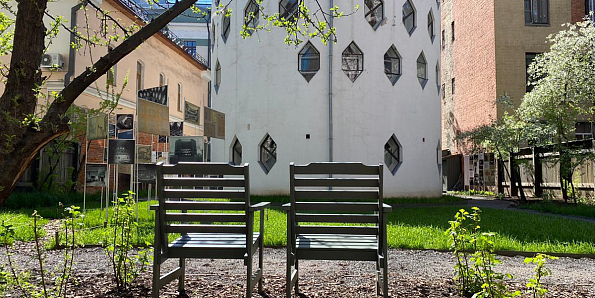
Melnikov built his house for himself and his family between 1927 and 1929. Two cylinders of differing heights intersect each other, with an almost five-metre-high stained-glass window facing Krivoarbatsky Lane, while the northern cylinder is punctuated by dozens of distinctive hexagonal windows. The design was experimental not only in its exterior appearance: Melnikov also tested his own construction techniques here, alongside a completely novel approach to organising living space for the time.
The guiding principle of restoration was minimal intervention. The house was examined layer by layer, with the aim of preserving as much of the original material as possible. Approximately 70% of the 1929 plasterwork on the façades survived, while around 95% of the historical elements in the enormous stained-glass window remain intact. To replace several missing panes, restorers had to search Moscow for thin, hand-rolled two-millimetre glass from the same era, as heavier modern glass could have placed excessive strain on the wooden structure.
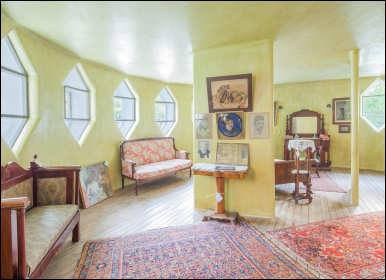
One of the most striking changes inside is the restoration of the original colour scheme. Over the decades, the house had been repainted multiple times, and restorers studied the sequence of paint layers to recreate the colours of 1929 as faithfully as possible. A special formula was developed for the walls, closely resembling the matte casein paints used by Melnikov. The bedroom proved particularly challenging: the golden space envisioned by the architect was meant to appear almost luminous once again.
Unexpected discoveries emerged during the investigation of the structures. The wooden ceilings, whose condition had raised concerns, were found to be in much better shape than anticipated. The issue lay in the later flooring installations, so the original principles of Melnikov’s construction were reinstated on the second and third floors. In the roof of the large cylinder, the cause of the cracks—something the architect himself had struggled with during his lifetime—was identified: the structure lacked an upper wooden sheathing. The missing element was added, adhering to the same construction principles employed by Melnikov.
The house itself has come back to life. Furniture, paintings, books, carpets, and light fixtures have been returned to their original places. During the restoration, around 25 artworks were restored, including pieces by Konstantin and Viktor Melnikov, as well as the living room carpet and other memorial items. It is this setting that makes the Melnikov House so paradoxical: one of the most radical architectural experiments of the 20th century remains, on the inside, a true old Moscow home where a specific family once lived.
The restoration was funded by Andrey Molchanov’s LSR Group. According to Forbes, the cost of the work amounted to approximately $2.5 million. The restoration project was developed by the architectural bureau Rozhdestvenka, led by Narine Tyutcheva.
Following its reopening, the Melnikov House will not become a museum with large crowds of visitors. Its fragile structures, narrow staircases, and small rooms still require a more intimate approach: tours will be limited to just five visitors at a time, excluding the guide and attendant. The restorers deliberately chose not to reinforce the historic ceilings solely to increase visitor capacity.
The courtyard is expected to partially address accessibility issues. During museum opening hours, it will be freely accessible, featuring an outdoor exhibition on the history of the Melnikov House and a weatherproof cutaway model of the building, allowing visitors to examine its unique structures. A shop will open in the former utility shed, where audio guides will also be available. Next summer, the museum plans to restore the Melnikovs’ garden and vegetable patch and host lectures, workshops, and film screenings in the courtyard.
Upon completion of the restoration, the Museum of Architecture intends to include the Melnikov House in the UNESCO World Heritage List. «At present, the Museum team is preparing the nomination dossier in accordance with the requirements of the UNESCO World Heritage Committee,» states the museum’s website. «Both Russian and international experts are confident that this outstanding monument of Russian avant-garde architecture deserves this prestigious status.»
In the first nine months of 2026, the number of tourist trips by foreigners to Russia increased by 3.45%. Moreover, over half of the international bookings at Russian hotels made via the Yandex Travel platform were attributed to visitors from China.
The Tretyakov Gallery is marking the 160th anniversary of Léon Bakst by showcasing the artist who transformed theatrical costume into a work of art—creating stage looks that became an integral part of the fashion landscape
The Hermitage celebrates the 175th anniversary of the Saint Petersburg–Moscow railway with an exhibition exploring how this new mode of transport transformed not only distances but also architecture, art, and the very rhythm of life in the country.
