The revamped Olympiyskiy and the new Great Moscow Circus will provide the capital with two cutting-edge venues for world-class shows, featuring innovations never before seen in global event infrastructure.
Two projects are unfolding almost simultaneously in Moscow, each with the potential to significantly alter the city’s position on the global map of grand spectacles. The reconstruction of the Olympic Stadium has already entered its final phase: the complex is approximately 80% complete, with major works scheduled for completion in 2027. Meanwhile, in the Mnyovniki floodplain, construction has just begun on a new building for the Great Moscow Circus, designed to host shows that are technically impossible to stage in a traditional arena. This ambitious project is slated for completion in 2029.
What these two construction projects have in common is not just their scale. In both cases, Moscow is betting on next-generation infrastructure: the spaces are designed not merely to host concerts or performances but to provide creators with technical capabilities that previously did not exist. Several of the solutions implemented at the «Olimpiyskiy» complex have already been officially recognised as world records; the new circus is described by city authorities as a facility unparalleled in its combination of technologies and stage capabilities.
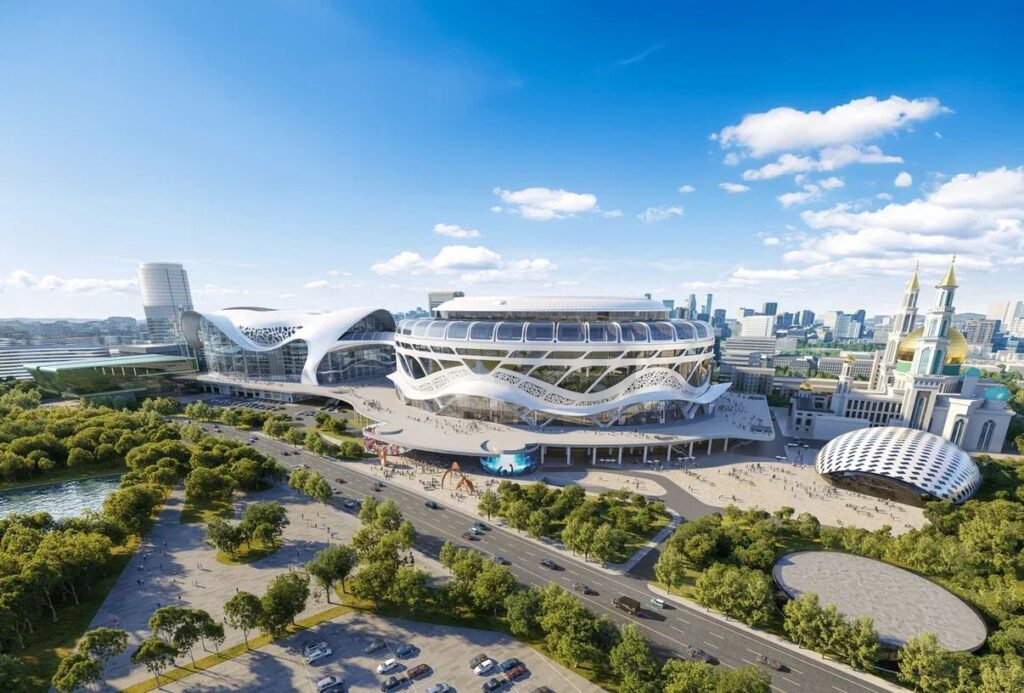
Originally constructed for the 1980 Olympics, the complex once stood as a symbol of modern engineering. Now, it is being effectively rebuilt as a vast sports and entertainment city spanning approximately one million square metres. The structure will comprise four facilities: the main building, the Aquatic and Fitness and Wellness complexes, and a separate Small Concert Hall complex.
The main intrigue lies in the grand concert hall designed to accommodate 12,000 spectators, which will be situated at a height of 50 metres. It has been registered in the BRICS Record Book as the first facility of its kind in the world. Visitors will ascend to the hall via a 72-metre-long «Star Escalator».
This is not the only global «first». At a height of 41 metres, there will be a kilometre-long indoor panoramic running track – also the first of its kind worldwide. Shaped like the infinity symbol, it will form part of the architectural connection between the main building and the Water Complex. Higher still, at 55 metres, a panoramic rotating restaurant complex will be located, featuring 38 distinct restaurant concepts – yet another world-first.
Another record is tied to water. The indoor Water Complex will span an area of 243,506 square metres, which the BRICS Record Book recognises as the largest of its kind globally. It will house 15 swimming pools, including Olympic-standard pools at a height of 41 metres, a water park, and spaces for beach sports, fencing, table tennis, and martial arts.
The scale of the project is further illustrated by another figure: the construction volume of «Olympic» amounts to approximately 6.5 million cubic metres, exceeding half the combined volume of the 12 towers of Moscow City. Currently, over 5,500 specialists are working on the site. Simultaneously, the city is constructing a new Dostoevskaya station on the Circle Line of the metro to integrate the complex into the capital’s main transport system.
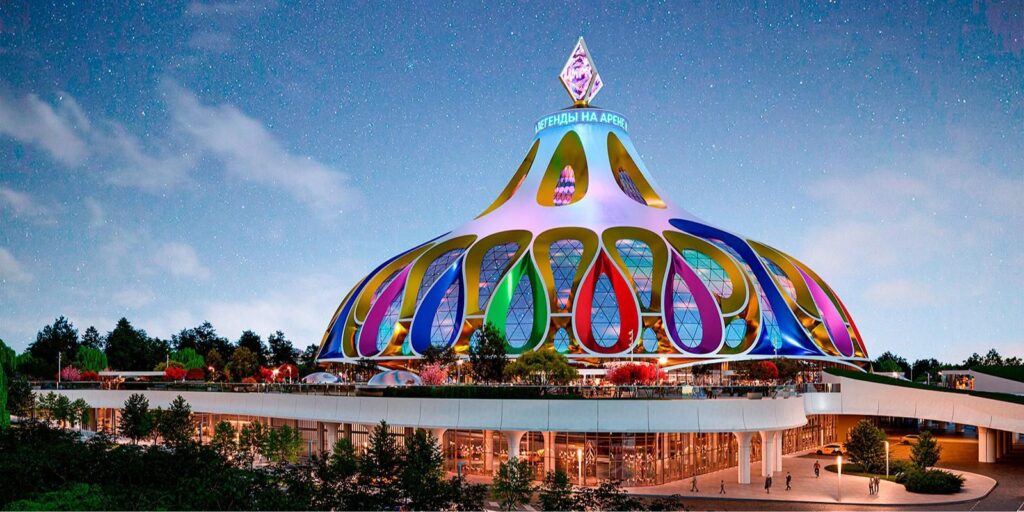
If the «Olympic» is set to restore one of Moscow’s key concert venues, the new Great Moscow Circus has an even more ambitious goal – to compete with the cutting-edge infrastructure of Las Vegas, Macau, Shanghai, and Beijing. These cities are precisely the examples cited by the circus’s general director, Edgard Zapashny, in a statement, highlighting them as centres where modern technical equipment has already become a crucial factor in the global competition for the best shows.
The main feature will be a modular arena with 11 transformation options. In just a few minutes, it can be converted from a traditional circus ring into a stage for equestrian acts, ice performances, water shows or multimedia productions – with the configuration even changeable during the performance itself. Beneath the arena, a multi-level technical hold reaching a depth of up to 28 metres will be constructed to house the mechanisms.
The Moscow Department of Culture unequivocally describes this array of features as unparalleled globally. Within a single building, there will be a LED arena, a swimming pool, an ice rink equipped with a freezing system, and a 26-metre «rain wall». For aquatic performances, over 200 controllable jets will be installed, capable of synchronising with music and the movements of performers, while the pool will include a specialised diving zone with a depth of up to eight metres.
Beneath an almost 100-metre dome, a system of winches, rigging and suspension mechanisms will enable the entire volume of the hall to be utilised for aerial acts and moving stage sets. The performance environment will be enhanced by kinetic structures, lasers, projection technologies, and more than a thousand lighting fixtures—according to Moscow’s Urban Development Complex, this exceeds the average level of modern circus arenas by 30–40%.
The complex itself will have a capacity of 5,000 spectators and a total area of 82,200 square metres. In addition to the main arena, the plans include a rehearsal ring, production workshops, spaces for creating stage sets and costumes, technical zones, and dedicated infrastructure for animals. Surrounding the building, a landscaped park will be developed, while the nearby «Mnyovniki» and «Terekhovo» stations of the Big Circle Line are already operational.
In the first nine months of 2026, the number of tourist trips by foreigners to Russia increased by 3.45%. Moreover, over half of the international bookings at Russian hotels made via the Yandex Travel platform were attributed to visitors from China.
The Tretyakov Gallery is marking the 160th anniversary of Léon Bakst by showcasing the artist who transformed theatrical costume into a work of art—creating stage looks that became an integral part of the fashion landscape
The Hermitage celebrates the 175th anniversary of the Saint Petersburg–Moscow railway with an exhibition exploring how this new mode of transport transformed not only distances but also architecture, art, and the very rhythm of life in the country.
