How the Russian medical tourism market is developing and why it holds enormous potential
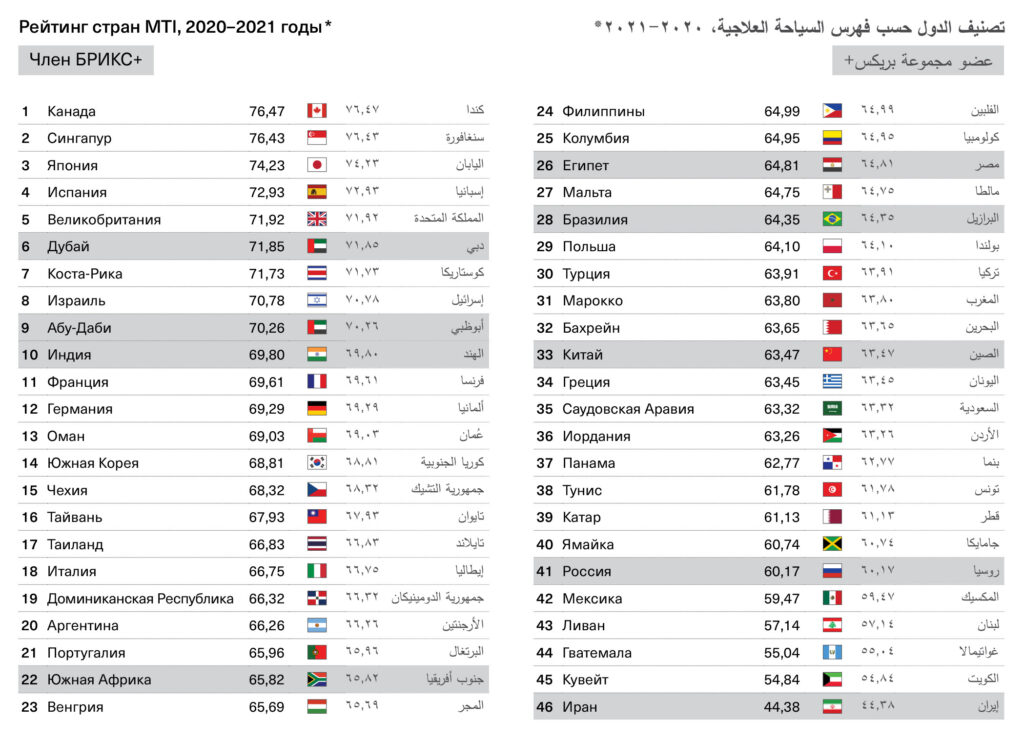
Medical tourism is one of the most promising areas of the global healthcare system: the market for such services is growing by 12% a year, and its volume could reach $350 billion by 2032. Russia has every chance of carving out its own niche, but there is still a long way to go: at present, the country ranks only 41st in the world for its appeal to foreign medical tourists. We examine what foreigners come to Russia to have treated, where Russian doctors excel, and how to develop this market with its enormous potential.
A medical tourist is someone who travels to another country or city for treatment and, health permitting, takes the opportunity to relax and explore new places. The motivation for such travel arises when a patient’s local healthcare system presents three types of “gap”. The first is technological: the necessary treatments or equipment are simply unavailable. The second is financial: a service or operation is prohibitively expensive, and the difference in treatment costs between countries makes the journey economically worthwhile. The third is regulatory: access to care is restricted by waiting lists, insurance or legislation. We shall not consider domestic medical tourism (when, for example, a resident of Tula or Khabarovsk travels to St Petersburg for an operation) and will instead focus on what Russian medicine can offer patients from abroad. Let us briefly outline the main advantages before examining them in greater detail — without forgetting, of course, those areas that still require improvement.
Compared with a number of other countries — the United States or Israel, for example — the cost of treatment in Russia is highly attractive: the difference in price can be tenfold or more, while dental care is typically four to five times cheaper.
Russian doctors and medical specialists receive an excellent education and possess vast practical experience, performing thousands of minimally invasive and non-invasive procedures each year — from endoscopic surgery to MRI-guided focused ultrasound therapy. Alongside state-of-the-art equipment, many clinics invest heavily in post-treatment recovery programmes, particularly following complex surgical interventions or rehabilitation after cancer treatment. Finally, Russia possesses enormous natural therapeutic resources, while obtaining a visa and entering the country is relatively straightforward.
Medical tourism was an inevitable consequence of the collapse of the Soviet Union: people who had previously travelled within the country for treatment continued to visit the trusted major medical centres that now found themselves abroad. The large commercial clinics that subsequently emerged in Russia picked up on the global trend for such travel and, from the outset, aimed to treat both Russians and foreign nationals. For example, the S. Fyodorov National Medical Research Centre “MNTK Eye Microsurgery” of the Russian Ministry of Health, one of Russia’s leading ophthalmology institutions, established in 1986, began receiving patients from abroad 35 years ago and has since helped 355,000 medical tourists from 139 countries, says Dmitry Buryakov, head of the centre’s department for the export of medical services.
In 2019, the state recognised the potential of the already existing medical tourism market and took the initiative, launching the federal project ‘Development of Medical Services Exports’. Patients arrive either on an electronic visa or on a business visa for the purpose of treatment. Pilot projects have been introduced with major clinics offering a full turnkey service — from selecting a doctor to arranging transfers and accommodation. With the support of the Russian Ministry of Health, the portal russiamedtravel.ru was created as a single point of access for foreign patients, where more than 250 clinics offer treatment and rehabilitation across over 30 medical specialities.
Medical universities have begun to place greater emphasis on language training in order to reduce the language barrier with patients arriving from abroad. In June 2025, the Medical Tourism Friendly certification system was launched with the aim of improving service standards. A federal law “On the Fundamentals of Medical Tourism in the Russian Federation”, which is intended to regulate comprehensive services at the intersection of medicine and accommodation, has not yet been adopted but remains under discussion (the Russian Union of the Travel Industry proposes clearly dividing responsibilities between tour operators and medical institutions, as will be discussed below).
Numerous medical tourism agencies help patients and their families find a doctor, enter the country and settle in. They act as intermediaries between the clinic and the patient, putting together package medical tours — preventive, rehabilitative and wellness. Their staff coordinate a preliminary treatment plan with the doctors, prepare the documents for hospitalisation and, where necessary, provide translation into Russian.
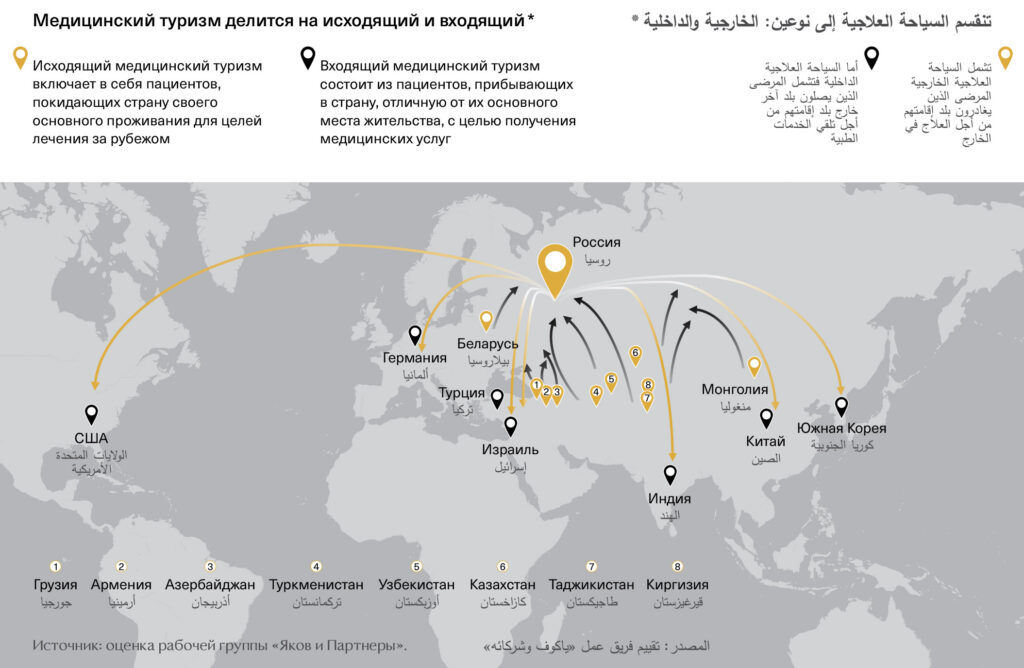
Around 80% of all foreign patients are citizens of Uzbekistan, Kazakhstan, Kyrgyzstan and Tajikistan. A significant proportion also arrive from the South Caucasus — above all from Azerbaijan and Armenia. The reasons are clear. Firstly, Russia enjoys well-established transport links with Central Asia, and citizens of these countries do not require visas. Secondly, there is virtually no language barrier. Moreover, many Russian regions are home to large diasporas that can assist new arrivals with practical matters: meeting them, providing temporary accommodation and explaining the details of everyday life.
Interest from China and the Middle East is growing ever stronger. In 2024 alone, 200,000 Chinese citizens received high-technology medical care in Russia, while representatives of Saudi Arabia took part in a strategic session on the export of medical services at SPIEF 2025. The flow of patients from South-East Asian countries to Primorsky Krai and Khabarovsk Krai, however, remains modest for now. This is due both to language barriers and to strong competition from medical centres in the Republic of Korea, Japan and China.
The major clinics taking part in the Ministry of Health’s “Development of Medical Services Export” project are investing heavily in technology, offering robotic surgery, gene therapy and radionuclide and radiation treatment (Russian clinics, incidentally, rank among the top 10 worldwide for the precision of their radiotherapy). Innovative reproductive technologies, cosmetic surgery and other high-tech disciplines are also advancing.
Oncological conditions are the primary reason patients travel to Russia for surgery and treatment. Since 2019, the N.N. Blokhin National Medical Research Centre of Oncology of the Russian Ministry of Health — the largest oncology clinic in Russia and Europe — has received almost 25,000 medical tourists, most of them citizens of CIS countries, as well as Georgia, Vietnam, China, Serbia, Latvia and Iraq, says Elena Iozhits, head of the centre’s international cooperation department. Patients can email their medical documents in advance for preliminary review by oncologists, which helps them decide on the timing of their visit and their course of treatment at the cancer centre. There are two hotels on the centre’s grounds, and foreign patients are also assisted with visa invitation letters. Accommodation and visa support are likewise available at the S. Fyodorov Eye Microsurgery Federal State Institution (MNTK) of the Russian Ministry of Health, whose staff speak English, French and Arabic.

In 2025, JSC Medicina (Academician Roitberg’s Clinic), a multidisciplinary family medical centre, received approximately 1,000 foreign patients seeking treatment, 300 more than the previous year; 150 of them underwent inpatient surgical treatment for oncological conditions, ophthalmic surgery (particularly paediatric), neurosurgery and cardiac surgery, as well as joint replacement and aesthetic procedures. Almost half of these medical tourists are citizens of former Soviet countries. Foreigners have been coming to the clinic since it was founded in 1990, notes Maria Greshilova, head of the services promotion department at JSC Medicina. Citizens of Muslim countries show particular interest in receiving treatment at this clinic, as it is certified to the Halal Tourism Standard with a Four Moons rating. The clinic’s doctors speak fluent English, and a professional interpreter is also available. Where necessary, medical documentation is provided in English or in the language of the patient’s home country.
Moscow and St Petersburg receive between 70 and 80% of all medical tourists. This is only natural: it is here that the country’s leading oncology centres, clinics specialising in rare diseases, and cardiac and general surgery units are concentrated.
The development of medical tourism as a distinct sector has been incorporated into Moscow’s tourism development programme through to 2030: by that year, this segment is expected to account for 3% of the total tourist flow, or approximately 1.6 million people in absolute terms. Achieving this will require building new resort and wellness complexes, developing medical tourism products and promoting individual leading clinics. From a service perspective, it also calls for pursuing international certification for Russian tour operators so that they can work to unified standards with clinics in EAEU, SCO and BRICS countries.
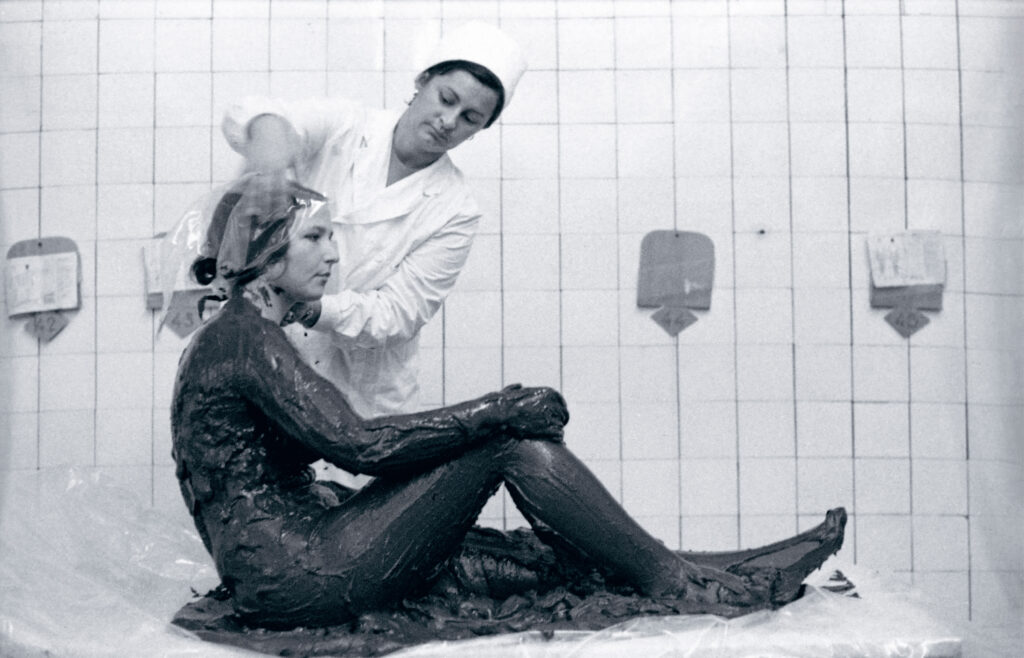
Naturally, there are centres of attraction beyond the capitals as well. Kazan draws patients in need of cardiac surgery: several large federal-level specialist institutions operate here. People travel to Omsk and Novosibirsk for dental treatment, while Obninsk in the Kaluga Region is considered a centre for neurosurgery: it is home to modern facilities specialising in the treatment of brain tumours, including Gamma Clinic. In southern Russia and the Altai, musculoskeletal disorders are treated and wellness and preventive programmes undertaken. For many years, the Belokurikha sanatorium in the Altai ran an early rehabilitation programme following heart attacks and cardiac surgery. “Now we offer visitors what our region, and our sanatorium in particular, is renowned for,” says Natalya Ignatovskaya, the sanatorium’s chief physician. “Nitrogen-siliceous, low-radon waters are used in baths and in the mineral pool; we perform eye and gum irrigations, head showers, gynaecological and urological procedures; and we address fertility issues and preparation for IVF. In 2025, around 40 foreigners came to us: most often they are residents of Kazakhstan, but we have also had patients from Germany, the Czech Republic and China.”

Citizens of Central Asian countries may travel to Russia for medical treatment without a visa. Nationals of most other countries require a visa for serious treatment. To obtain one, you will need an invitation from the clinic and, in some cases, insurance and proof of payment for the treatment. Such a visa may be single- or double-entry, valid for up to three months, or multiple-entry, valid for up to one year.
This visa is required, in particular, for citizens of China (where the visit involves planned treatment rather than a tourist trip to see a doctor), India, most African countries and a significant number of Arab states. The exception is Saudi Arabia, for which a visa-free regime will be introduced on 11 May 2026. Citizens of the UAE need a visa only if they plan to stay in Russia for more than 90 days within a six-month period; they may spend three months there without one. Jordanian citizens may receive treatment in Russia without a visa for 30 days, after which they are obliged to leave. Citizens of Oman may enter without a visa for 14 days.
If a medical institution officially invites a foreign national, processing the documents can take up to three or four weeks. Moreover, the status of inviting party places considerable risk on the clinic: any breach by the foreign patient may create problems precisely for the medical institution. This discourages active engagement with countries whose citizens require visas.
Between 2019 and 2024, more than 21.5 million foreign nationals visited Russia for medical treatment, including 5 million in 2024 alone (although the statistical methodology is imperfect: in Russia, a ‘medical tourist’ is defined as any foreign national receiving any medical service whatsoever, including migrants undergoing mandatory health checks). There is hope that the numbers will continue to rise, thanks at least in part to China. According to the authors of the study Unlocking the Potential of Medical Tourism in Russia by Yakov & Partners, the Russian medical tourism market could be worth between $2.2 billion and $7.6 billion by 2030. Among the factors slowing growth are the departure from Russia of certain international medical companies and accreditation systems, along with difficulties in booking flights, paying for hotels and settling medical bills due to banking restrictions.
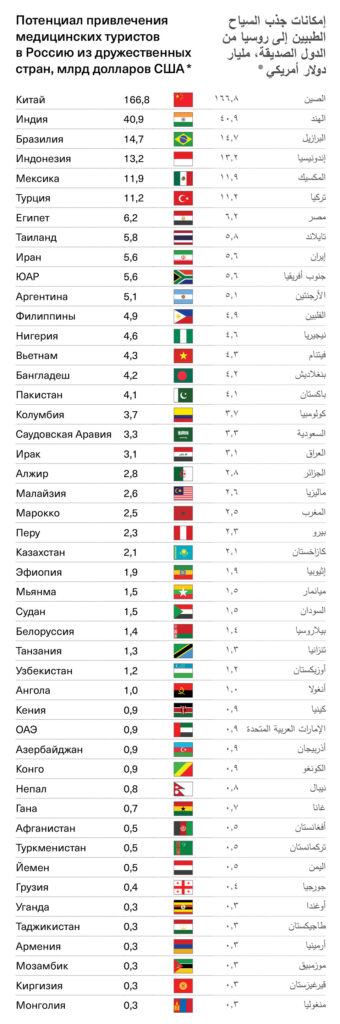
Where should Russian clinics and officials direct their efforts to attract people for treatment in the country? Who should be invited first? After all, Russia genuinely possesses considerable potential for attracting patients from friendly nations.
Experts at Yakov & Partners have divided these countries into four groups. The most important is considered to be the group of states geographically close to Russia that possess a high potential for outbound medical tourism: this comprises 10 countries with a combined potential of more than $250 billion. Four of them are members of BRICS+. China and India hold the greatest potential within this group. Among patients from these countries, oncology, ophthalmology and cardiology are in particularly high demand.
The second most significant group comprises the countries of the Middle East — above all Saudi Arabia and Iraq — along with a number of African states. The S. Fyodorov National Medical Research Centre “MNTK ‘Eye Microsurgery’” of the Russian Ministry of Health plans to develop this direction, as Dmitry Buryakov confirms: “The strategy provides for extending the remit of the national medical research centres and transferring our experience abroad — to the CIS countries and further afield — in particular by seeking new contacts in the promising regions of the Middle East, North Africa and Central Africa.”
It is equally important to work with the third group of countries — those that possess high potential but lie far from Russia. Brazil, Indonesia and other nations in Latin America and Southeast Asia are cases in point. Russian medical institutions could open representative offices and medical bureaux there, promoting treatment programmes for oncological conditions, heart disease and eye disorders. This would help not only to attract an additional flow of patients, but also to strengthen Russia’s international reputation as a provider of high-quality medical services.
Ultimately, medical tourism is not merely about medicine; it is a comprehensive service. A patient does not simply travel for treatment but lives through an entire experience — from the journey and accommodation to interactions with doctors and the system as a whole. It is precisely the quality of this ecosystem, rather than the calibre of the physicians alone, that becomes the key factor in competitiveness. On the whole, patients are prepared to travel to almost any region, provided the treatment meets several basic requirements: strong specialists, a reasonable price and suitable infrastructure.
In theory, any clinic can attract patients from other regions and countries. And if it offers rare but sought-after services, doing so becomes especially important. Russia already possesses a strong medical foundation. Now the main challenge is to turn it into a convenient, straightforward and trustworthy proposition for the foreign patient.