Moscow Fashion Week has once again brought together Russian and international participants on a single platform, presenting a broad spectrum of the contemporary fashion industry – from young regional labels to established houses
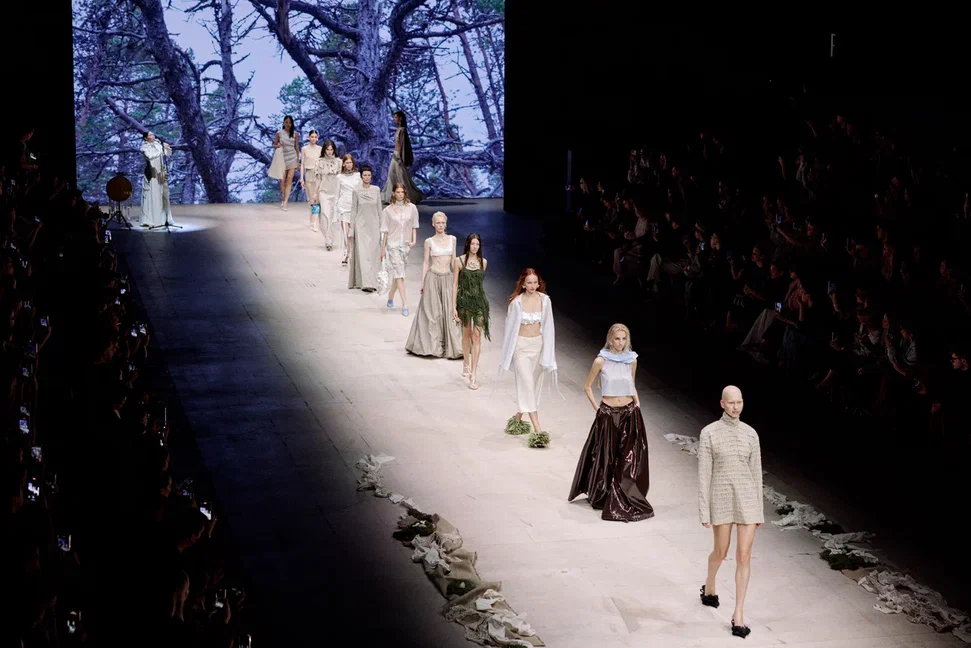
The seventh season of Moscow Fashion Week brought together more than 350 designers from 24 Russian regions and over 10 countries. The programme featured almost 100 shows, while the showroom presented more than 90 brands. At the same time, Moscow hosted the BRICS+ Fashion Summit, uniting representatives of the fashion industry from over 60 countries.
The scale of the project also carries a significant business dimension. By the end of the previous season, participants had signed more than 70 partnership agreements, while the value of the deals under discussion exceeded 400 million roubles. Fashion Week is becoming a platform not only for presenting new collections but also for professional networking between Russian brands, manufacturers and representatives of the international industry.
One of the defining features of the seventh season was the designers’ engagement with Russian culture. Folk crafts, regional history, folklore and natural imagery appear throughout the collections, no longer as a literal reconstruction of traditional dress but as material for contemporary fashion.
Against the backdrop of the event’s sheer scale, it is particularly interesting to see how Russian fashion is taking shape at the level of individual collections. Watch Russia has gathered several of the most intriguing projects from the seventh season and introduces the designers who each approach Russian culture, regional identity and the contemporary language of fashion in their own way.
Vereja has transformed the traditional fashion show into a concert-presentation, “Keepers of Reya”. The project serves simultaneously as a retrospective of the seven-year history of the artistic universe created by the brand. Here, clothing exists at the intersection of handcraft, knitwear, folklore and contemporary art, while traditional motifs become part of the label’s own mythology. Running in parallel, the All-Russian Museum of Decorative Arts is hosting Vereja’s exhibition “Beyond the Window Casing”.
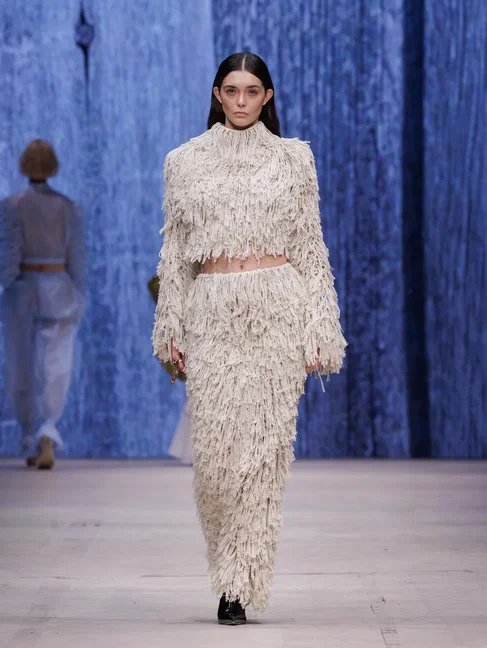
Alexandra Gapanovich presented her “Weathered Light” collection, built around the image of the ammonite — an ancient shell shaped by water and wind over millennia. This motif finds its continuation in cocoon-like volumes, asymmetry, layering and complex textures. Some surfaces recall fishing nets, scales and marine minerals. Here, the northern aesthetic exists without direct reference to traditional costume, forming a visual language entirely of its own.
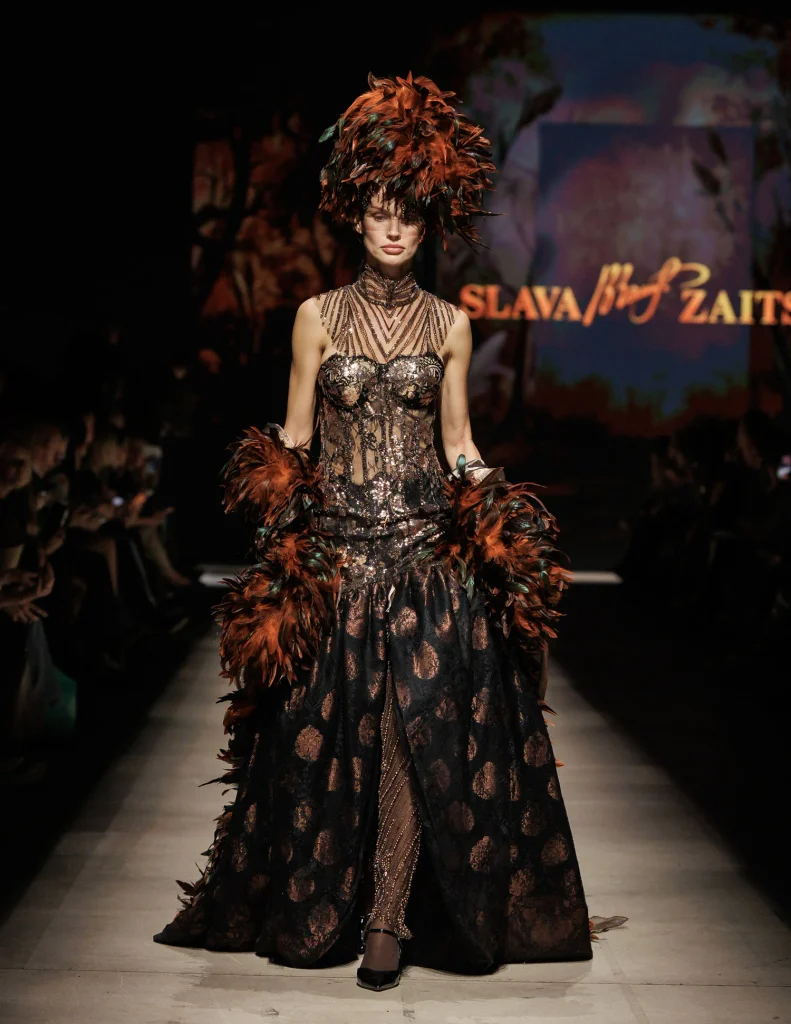
The Slava Zaitsev fashion house has presented the Dédicace au Créateur (‘Dedication to the Creator’) collection – its first major couture offering since the death of Vyacheslav Zaitsev. It was created by Nikolai Krasnikov, who was trained by the house’s founder himself. More than 40 looks were crafted using antique fabrics, natural silk, damask brocade, Vologda and Yelets lace, Rostov finift enamel, and hand embroidery with seed beads and pearls. These historic materials and techniques form the foundation for continuing the house’s aesthetic in a new generation.
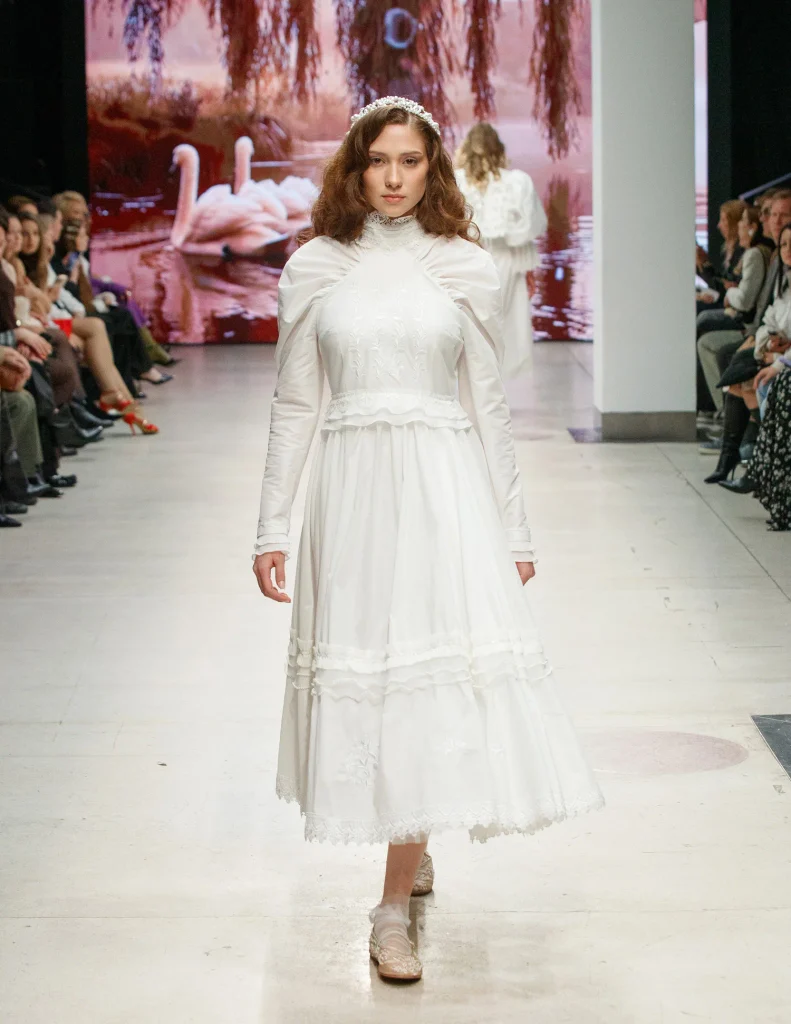
An enterprise from the village of Kholui, in collaboration with Kosygin Russian State University, has presented an entirely white collection that reinterprets Russian wedding traditions. Kholui drawn-thread work is combined with openwork surfaces, capes, tiered skirts, veils and contemporary interpretations of traditional headdresses. Following the debut show, representatives of the project reported a rise in sales and an increase in followers. In this instance, a traditional craft becomes not only a means of preserving heritage but also a fully fledged tool for the modern fashion industry.
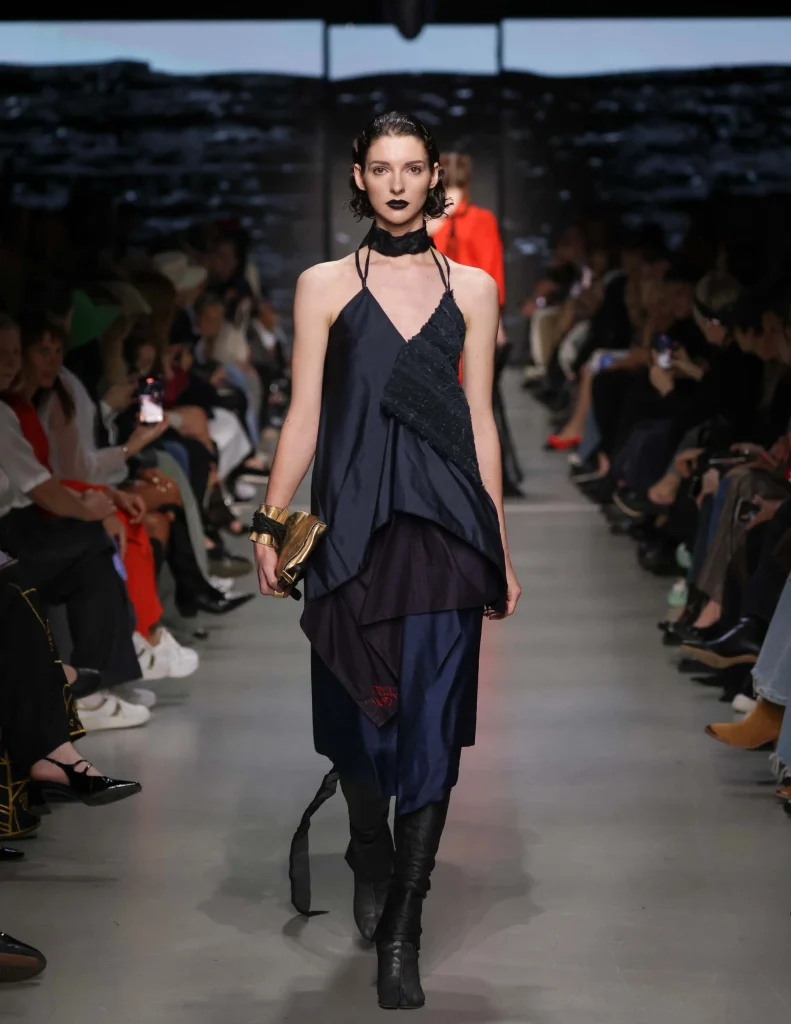
The Krasnodar-based label Les Noms has turned to the material culture of 19th-century Kuban. The collection employs vintage fabrics, embroidery, generous cuts and elements drawn from the practical Cossack wardrobe. Yet the designers do not reproduce traditional dress literally. Regional identity is conveyed through materials, silhouettes and individual details, becoming part of contemporary everyday clothing.
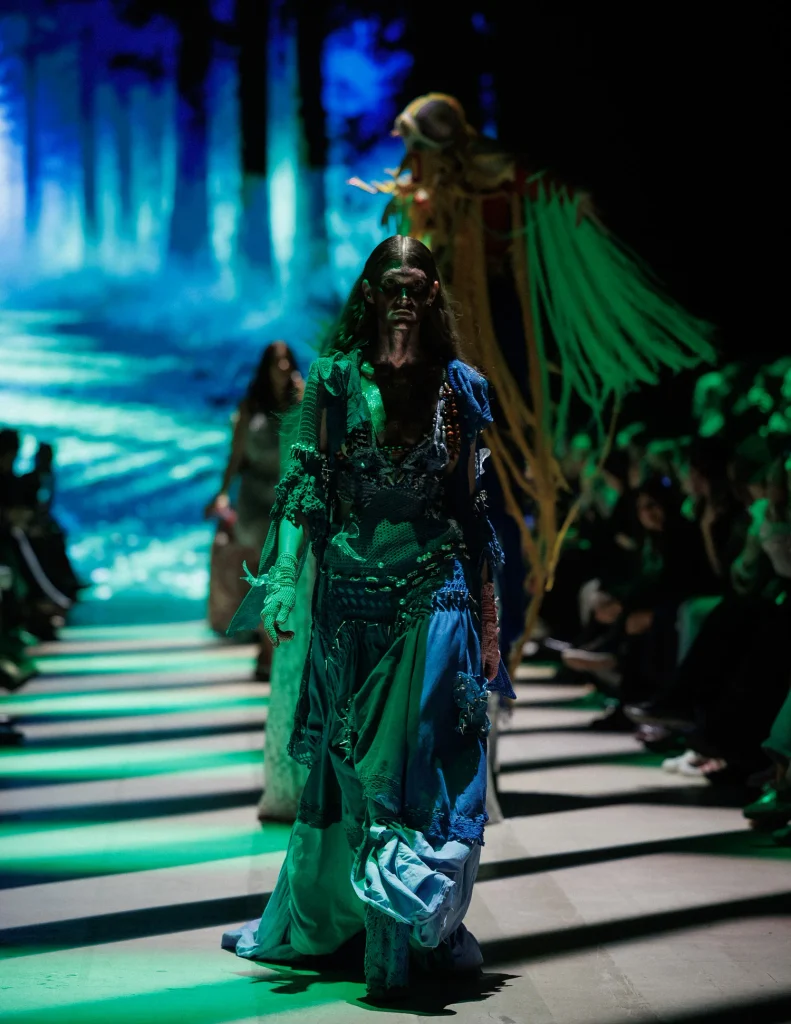
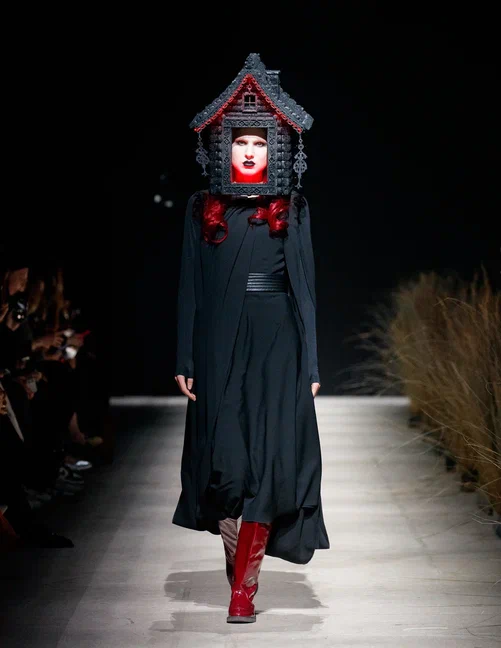
The costumes designed by Igor Chapurin for “Russian Fairy Tales”, a ballet by Pyotr Dranga, were presented as a fashion performance. Through contemporary silhouettes, the designer reinterpreted the characters of “The Magic Swan Geese”, “Kolobok” and other fairy-tale plots. Hand embroidery is combined with experimental materials and sculptural constructions. Among the most striking details are Baba Yaga’s headdress in the form of her hut, along with moss and cobweb textures.
The seventh season of Moscow Fashion Week revealed several distinct approaches to working with Russian culture in contemporary clothing. The northern landscape, regional history, traditional crafts, the Russian fairy tale and personal mythologies all serve as sources for new visual solutions. In these collections, tradition is not copied literally but reinterpreted through materials, techniques, silhouettes and cultural codes.