The legendary dacha settlement of Komarovo near St. Petersburg, which still remembers the footsteps of Anna Akhmatova, Dmitry Likhachev, and a whole constellation of great physicists and poets of the 20th century, is experiencing a second birth today. The Autonomous Non-Profit Organization «Big Cultural Project» is launching a large-scale program to revive this historic space. Anna Grogol — theater scholar, producer, and General Director of the «Big Cultural Project» — talks about how the spirit of the Leningrad intelligentsia is coming back to life, why they want to recreate Villa Arfa in Komarovo, and how an alliance of young scientists and theater professionals can transform the landscape of Russian culture.
For over a century, Komarovo (formerly Kellomäki) was a unique sanctuary of the Russian intelligentsia. Here, under the canopy of ancient pines, Anna Akhmatova, Dmitry Shostakovich, and Yevgeny Schwartz created their works; here lived titans of science and Nobel laureates. Our overarching goal is not to turn this place into a museum exhibit behind glass, but to restore the very atmosphere of living, pulsating creative and scientific exploration. We want the historical code of Komarovo to work once again for the country’s future.
The Ark residencies are conceived as a flexible, living ecosystem for co-creation, research, and the realization of artistic projects at the intersection of disciplines. Here, writers, poets, scientists, composers, musicians, artists, directors, choreographers, and playwrights will be able to join forces to create fundamentally new interdisciplinary statements, erasing the boundaries between scientific inquiry and performing arts.
But we must also speak about the people and cultural venues that have existed in Komarovo for many years. Today, the walls of the Komarovo library and museum are places that literally bear the entire historical memory of this settlement. Yet we understand the difficult conditions under which these institutions operate today, and how hard it is for them to preserve their archives, artifacts, and the very atmosphere itself. It is a daily, selfless labor carried out with no funding. The Komarovo library and museum are today the outposts of our culture. Their situation is incredibly difficult: they lack resources and constantly fight for every document, for every meter of space. But what they do is a feat of heroism.
The incredible women who were at the origins of the museum and library’s creation and spent decades piecing together the history of the settlement bit by bit: Irina Snegovaya (local historian), Elena Travina (local historian), and Elena Tsvetkova (head of the library). It is thanks to their fundamental research and dedication that we know the real Komarovo today. Ekaterina Boyarskaya is the head of the Komarovo Museum, who carefully develops the museum in a single small room inside the municipal building. And please note their telling surnames.

Exactly! Our main goal is not to remake everything in our own image, but to breathe new hope into this place and offer powerful support to those who have been pulling this heavy load alone all these years. Today, the museum and the library are striving to gather in one place everything created and left behind by the great people of the past. We are joining forces so that these archival treasures can become the foundation for the present day. Because Komarovo cannot be measured by utilitarian, commercial yardsticks. As I always say, this space should be scaled up and understood not by market standards, but by looking to the world’s great artistic spaces, such as Abramtsevo.
They see this as a continuation of their life’s work. When 50 young people come to the museum and library—talented researchers, physicists, and engineers together with directors, musicians, and playwrights—who study the archives in order to create projects at the intersection of science and theatrical art, the museum staff literally feel their wings spread. We breathe hope into Komarovo. We show that memory has not died; it is transforming into the energy of the future. The museum, the library, our «Great Cultural Project,» and these young creators have today become one whole within the «Komarovo Ark of Culture.»
Komarovo is remarkable in that new meanings and projects constantly take root here. For example, on the way to the Komarovo Cemetery, to Anna Akhmatova’s grave, between Pervaya Dachnaya and Vtoraya Dachnaya streets, a completely unique ParkArt has emerged today.
It was created by remarkable people – biologist and artist Natalia Koryakina together with Andrey Vinogradov. Imagine a forest where art objects of incredible beauty and depth are placed right on living trees, organically woven into the natural environment. Natalia works on the principle of «growing» culture directly in the wild – exactly as Slava Polunin does at his legendary «Yellow Mill» near Paris. This ParkArt in the Komarovo forest is living proof that Komarovo continues to attract free-thinking artists who do not impose themselves on nature, but speak its language.
At the very beginning of Pervaya Dachnaya Street, an unusual fence with skis immediately catches your eye. Behind it lives the amazing photographer Alexander Alakrez, a man who for many years has been devotedly and subtly capturing the soul of Komarovo in his works.
His photographs are not merely reportage or a record of a landscape. They are the highest form of artistic expression. Alexander employs various unique techniques, such as shooting through mirror reflections. The result is deep, mystical works filled with immense spiritual meaning.
Looking at his photographs, you begin to feel more acutely the same sensation you get when watching Andrei Tarkovsky’s film «Stalker,» whose screenplay was written here by brothers Arkady and Boris Strugatsky: Komarovo is not just a dacha settlement, but a true portal between worlds. You know, like the sacred city of Varanasi in India, where the physical world touches eternity. In Alexander’s photographs, Komarovo looks exactly like that: a mystical space where time stands still and nature becomes a gateway to another dimension. Not long ago, he held a large solo exhibition dedicated to Komarovo, and it became a true revelation for everyone who loves this village and understands its intimate language.
The co-chair of our project’s jury is Andrei Moguchy – an outstanding director, a man of absolute creative freedom, who has also lived in this village for many years, breathing its air and feeling its pulse. Alexei German Jr., Alisa Freindlich, and representatives of the Piotrovsky and Boyarsky dynasties also live here permanently…
This is an unbroken tradition. In Komarovo, there is no need to «invent» culture — here it is enough to simply look around, step onto a forest path, or drop in on a neighbor for a cup of tea to understand: this place continues to hold the core meaning of our entire country. And our task is to ensure that this unique intellectual reserve does not dissolve over time, but instead resonates at full strength during this new turn of history.

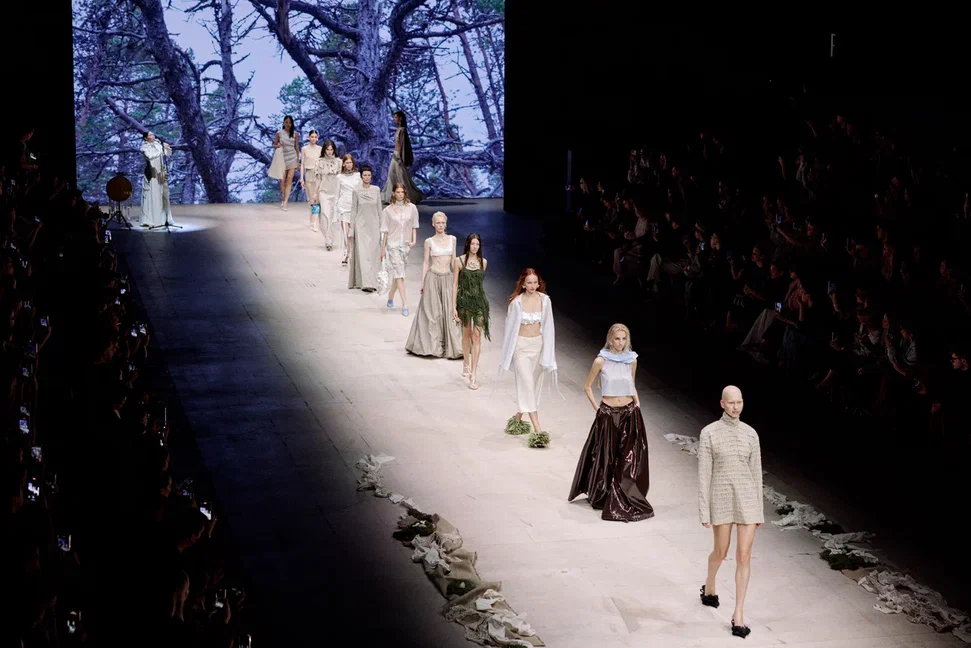
Exactly. Our mission is to restore a living dialogue between science and art. When I see young physicists and musicians coming together to create something fundamentally new, I realize we are on the right path. We are turning Komarovo into a living laboratory where science and art begin to cross-pollinate. Historically, Komarovo was built as a settlement where an academic campus stood alongside writers’ dachas, giving rise to that very legendary dialogue between exact knowledge and artistic insight. We have decided to revive this synthesis at a new level. We are hosting a special creative residency, inviting around fifty participants — young researchers, scientists, scenographers, directors, playwrights, and performers. Imagine a fusion of young academic thought and bold theatrical experimentation.
Exactly. Young physicists, mathematicians, engineers, and performing artists will work together on joint project initiatives. At the intersection of science and theater, truly astonishing meanings are born — just as the Strugatsky brothers once wrote their «Roadside Picnic» here, pushing the boundaries of the familiar world. Our task is to give these talented young people a space for dialogue, to provide them with creative freedom and the best conditions so that they can get ahead of their time, just as our great predecessors did. Our Art & Science residency in Komarovo is pure creativity, exploration, and reflection.
Art & Science in Komarovo is not just a lecture series or a trendy buzzword. It is an attempt to go beyond the familiar. It is not about where scientific knowledge becomes dramaturgy and performing art becomes a tool for exploring reality. It is about the attempt to find a new language of our time.
We are breaking down the wall between the «techie» and the «humanities person.» A young scientist accustomed to working in a lab with instruments suddenly realizes that their research can become a powerful metaphorical statement. And a director, through a scientific approach, gains access to tools that make their production deeply grounded.
Komarovo is the perfect testing ground for such an experiment. There is no hustle and bustle here to disrupt concentration, but there is a powerful intellectual aura of the place that inspires the search for answers to the questions: how technology changes people and how art helps us not lose our humanity in this process.
You know, when we were just beginning to make sense of the space of Komarovo, many people said: «This is history, it can only be remembered.» But I am deeply convinced that a true «place of power» requires not the conservation of ruins, but the restoration of its architectural and conceptual landmarks. Villa «Arfa» (Harp), designed by Gavriil Baranovsky — the brilliant architect who built the Eliseyev Emporiums and St. Petersburg’s first Buddhist datsan — is not merely a monument of wooden architecture. It is the quintessence of the Silver Age within a single settlement. Imagine this incredible house crowned with a delicate metal structure, which is why it was poetically called the «tower with a harp.» Music resounded there; there the destinies of Chaliapin, Kshesinskaya, and Fabergé intertwined.
For me and for the entire team of the «Great Cultural Project,» this is not just work – it is a mission. The philosophy of our project rests on three pillars: science, education, and art. And Komarovo has become that point on the map where these three elements converge into a single harmonious system. I have a deep, very personal connection to this place. You know, in front of my house, Nicholas Roerich’s Banner of Peace is carved into the cobblestones – art, science, and education within the circle of culture. This symbol has become both the meaning of my life and the manifesto of our program. It is the foundation upon which we are building our entire future. And it was precisely Komarovo, with its unique aura, that allowed these meanings to take on flesh and blood.
Of course. My family is inextricably linked to the people of Komarovo. My father — the renowned choreographer and People’s Artist of Georgia, George Alexidze — worked closely with Oleg Nikolayevich Karavaychuk. Imagine this creative partnership: Oleg Nikolayevich composed music that became the very soul of the choreography; together they worked on creating my father’s choreographic miniatures. It was a truly cosmic fusion of Karavaychuk’s brilliant music and Alexidze’s innovative movement. And when today we speak of reviving Komarovo, of preserving this great cultural code, for me it is not some abstract story from textbooks. It is the memory of my father, of Karavaychuk, of those people who created here beyond time. By reviving this spirit, we repay our debt to those great masters whose voices and sounds have remained forever among these pines.
The 120th anniversary of Dmitry Shostakovich is currently being celebrated, whose dacha plot is now occupied by a closed kindergarten… This historic site is falling apart, just like many other cultural and architectural monuments.
In December 2027, it will be exactly 100 years since the birth of Oleg Karavaychuk, and for us this is not just a milestone date. Oleg Nikolayevich created music that serves as a philosophical reflection on life, a kind of «sound architecture» of time. We have a duty to ensure that this legacy is not only preserved, but also resonates with a new generation of young scholars and artists who are currently working in our residencies.
We are at the very beginning of a long journey. Residences for «physicists and lyricists,» the return of literary prizes, the restoration of infrastructure and memorial sites — these are all stages of a major revival program. Komarovo must once again become a place that attracts the finest minds and creators from all over Russia.