Nidal Salim, Director of the EMC Oncology Institute, on Moscow, the dacha and why one must be not only a good specialist but also a kind companion to one’s patient.
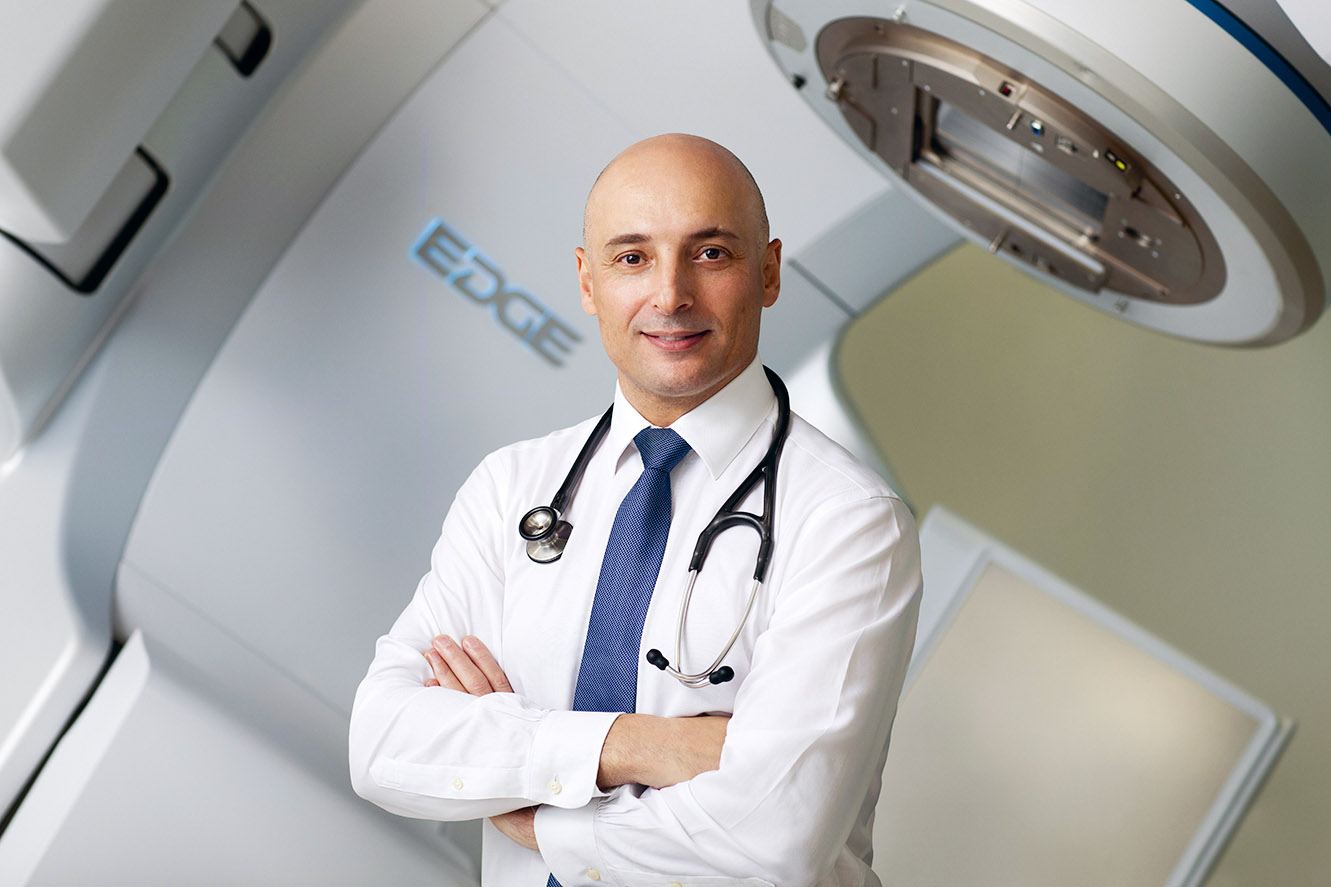
Nidal Salim was born in Bethlehem, studied and worked in Jerusalem, where he established an oncology centre for Palestinian patients, and then came to Moscow — initially for a year, to launch a new project for the European Medical Center (EMC), one of Russia’s leading private clinics. In the end, however, he stayed. We spoke with Dr Nidal Salim about what surprised him in the Russian capital and why modern oncology is impossible without technology, trust and clinical freedom.
You came to Russia to build an oncology centre from scratch. Why did you agree to move to a new country with a completely unfamiliar climate?
I have been here in person since 2016, but the project began earlier — around 2012. At that time, EMC did not yet have a fully fledged oncology department, and Russians were travelling to Israel in large numbers for treatment. I was working in Jerusalem at Hadassah University Hospital then, and I saw many patients from Russia.
Oncology is not the sort of medicine where a patient receives a service and simply goes home. It is an arduous journey: diagnosis, treatment, complications, family support. Patients were flying back and forth, spending their strength and money, contending with another language, a different culture and unfamiliar daily life. And at some point an idea emerged: why not bring the expertise here rather than the patient? To create a centre in Moscow of such a standard that nobody would need to fly to another country for help.
By that time I already had experience of building an oncology centre from scratch. In Jerusalem, at the Augusta Victoria Hospital, we delivered a major project for Palestinian patients.
Do you remember your first impressions of Moscow?
I flew in at night, in November. I got up in the morning, drew back the curtains — darkness. I glanced at my watch: 8 a.m. I thought to myself: this probably isn’t for me.
Then I was shown a building on Shchepkina Street. It had been designed as an office block rather than a hospital, with car parks on the minus first and minus second floors. Yet we wanted to install radiotherapy equipment there, along with a cyclotron, heavy machinery and bunkers with enormously thick walls. The engineer who had designed the building said: “You’re mad. It’s impossible.” And he refused to work with us.
We found other engineers and began converting the space into an oncology centre. What the patient sees now is only a small part of it. Behind the walls lies an enormous technological infrastructure, including a cyclotron.
In radiotherapy, equipment is updated very quickly, roughly every five years. We built three bunkers from the outset, even though we initially purchased only two machines. At the time, many people asked: why a third? You won’t have that many patients. I told them: believe me, it will be needed. Two years later, it genuinely was.
But the equipment alone solves nothing. You need people who know how to operate it. We recruited Russian doctors, physicists, radiotherapists and technologists, and trained them.
Were you planning to stay in Russia?
No. I held the position of director of the oncology institute at Augusta Victoria Hospital. I took a sabbatical — a year’s unpaid leave, as is customary in Israel. My task was to help build the centre, train the team, get it up and running, and return.
Then I extended my leave for another year. And then I realised that I had built the department of my dreams here. In Israel, I had excellent doctors, a school, patients, but also a great deal of bureaucracy. Here, I had the chance to do what I believed was right: to buy the best equipment, establish the process, assemble a team and create medicine that does not follow the standard but leads it.
In your view, how does Russian oncology differ from the school you came from?
In Russia, oncology long developed as a surgical school; here, an oncologist is often first and foremost a surgeon. In Israel, the United States and Europe, oncology grew out of internal medicine: a physician may become a cardiologist, a gastroenterologist, a pulmonologist — or an oncologist. It is a different logic altogether.
In international practice, an oncologist does not necessarily operate. There is a surgeon who operates on cancer patients, but he does not replace the clinical oncologist. In Russia, things have historically developed differently, and because of this, surgery sometimes remains the first response where other options already exist. I am not against surgery, I am against doing it automatically, because sometimes an operation is needed, and sometimes it is not. Sometimes it is possible to preserve the organ, its function and the patient’s quality of life.
The approach to rectal cancer treatment that you proposed has now been incorporated into international guidelines. Could you tell us more about it?
When I arrived in Russia, rectal cancer here was most often treated according to the following scheme: surgery first, then chemotherapy. Elsewhere in the world, radiotherapy was already being used before surgery, but I proposed going further: radiotherapy first, then chemotherapy, then an assessment of the response, and only after that a decision on surgery.
The idea was that a complete response could be achieved in some patients, allowing surgery to be avoided. At an international conference in Chicago at the time, one of the experts remarked: if you are doing this in Moscow, you are several years ahead of us. In 2023, a similar approach was incorporated into American guidelines as Total Neoadjuvant Therapy.
For me, this is an important example. Russia could be setting standards rather than merely adopting them. But to do so, one must believe that world-class medicine can be practised here.
At EMC you have created a model in which the patient completes their entire journey within a single building. Why is that so important?
A cancer patient should not have to run between different buildings, doctors and systems. For them, it is agonising. At our hospital on Shchepkina Street, everything is gathered under one roof. The patient enters the system and is never left alone. They have a doctor who oversees the entire pathway.
I believe an oncologist should be not merely a specialist, but a companion to the patient. It is a journey we undertake together. If something breaks down along the way, we do not abandon one another in the middle of the night.
A patient given a cancer diagnosis almost always takes it as a death sentence. The first question in their mind is: “When will I die?” Even if it is an early stage, even if the prognosis is good, at first the person hears only one word: cancer. In such a situation, the doctor acquires enormous power. The patient is ready to do whatever they are told. But for me, a patient’s trust is not the pinnacle — it is the baseline. What matters is something else: can I trust the patient enough to make difficult decisions together with them, including unconventional ones? Do they understand that in oncology there is no 100 per cent guarantee? That we can do everything right and still not achieve the perfect outcome?
At medical school they told us there are two opposite departments — the maternity ward and oncology. People are born in one and die in the other. But at some point I realised I wanted to turn oncology into a maternity ward. Only in my maternity ward people are born at 40, 50 or 60.
You are involved not only in treatment but also in education. Why is that important?
Because a single centre cannot change the system without a school. Today, EMC is a clinical platform for several educational projects. We work with Moscow State University and collaborate with RUDN University and the Russian Medical Academy of Continuous Professional Education. We also have our own EMC Medical School. When we speak about modern oncology, physicists, radiologists, technologists and doctors must all speak the same language. And that language has to be taught.
What surprised you about Russia — not as a doctor, but as a person?
Moscow. I’ve been to New York, Chicago, Boston and the European capitals, but for me Moscow is one of the most functional cities on earth. Here you can live, work, eat well and get things done quickly. The best fettuccine I’ve ever had was in Moscow, and the best steak too — even though you’d expect that to be in Italy or Argentina.
At first the winters were hard, but then I got used to them. Now I can sit at my dacha, look out at the snow and feel happy. My grandmother used to say: if you live among a people for 40 days, you become one of them. I have long been thinking in Russian; I no longer translate in my head.
I feel close to Russian people. They can be blunt, they can argue, they can shout, but they are genuine. In Russia I built the branch I had always dreamed of. That is why I am here.