Soprano Khibla Gerzmava on launching an opera workshop, the Colchis in each of her heroines, and the opera that teaches us to feel.
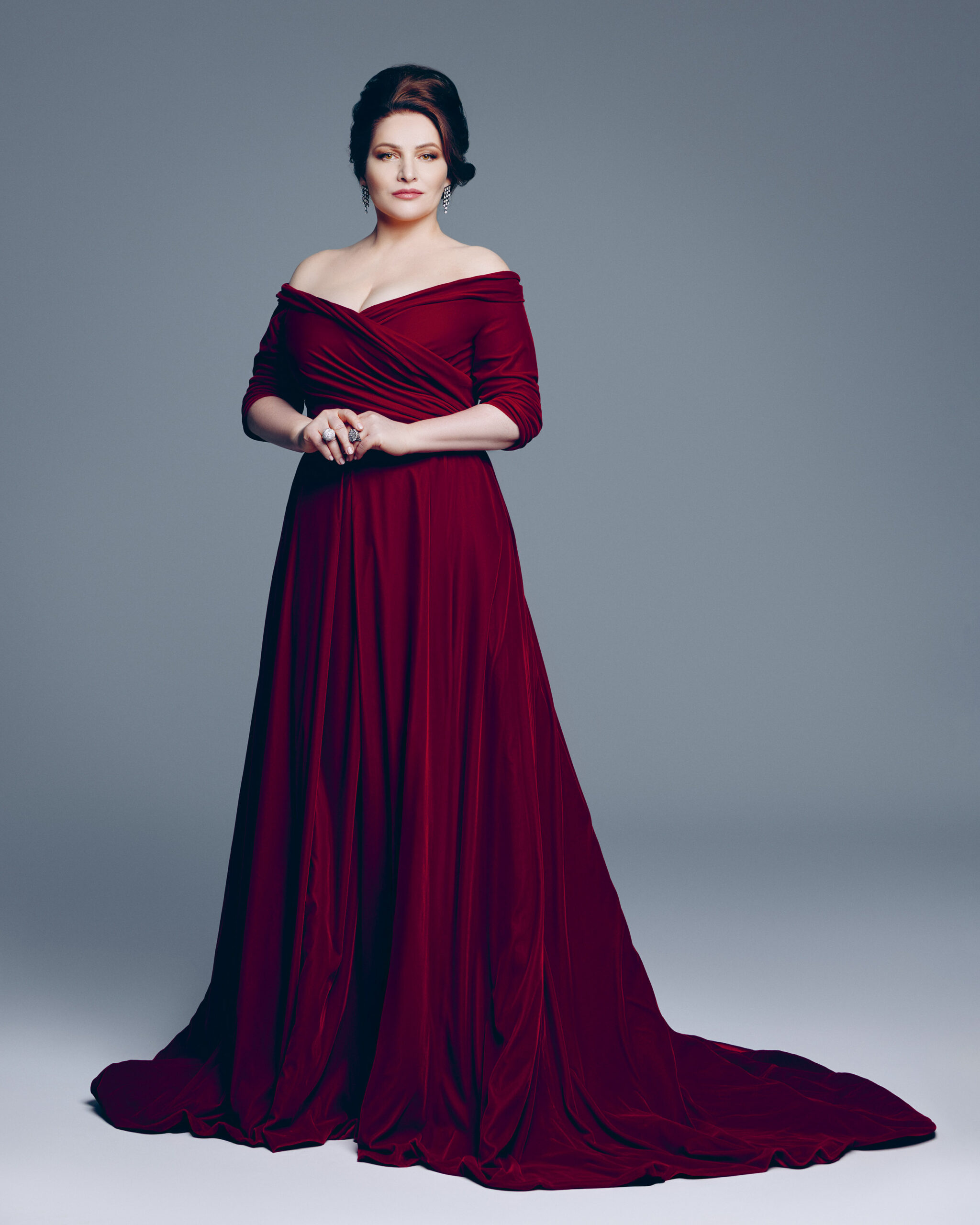
People’s Artist of Russia and Abkhazia and soloist at the Stanislavsky and Nemirovich-Danchenko Moscow Academic Music Theatre (MAMT), Khibla Gerzmava is one of the most sought-after singers of our time. Yet for many years now she has done far more than simply perform great operatic roles on stage herself: she has taken on a mission to preserve high musical culture, opera and the Russian vocal school in this world. To her two well-known projects — the music festival ‘Khibla Gerzmava Invites…’, founded back in 2001, and the International Competition of Vocalists and Concertmasters, launched in 2022, of which Khibla also chairs the jury — a third is now being added: an opera workshop. This new educational project will begin in summer 2026 in Sochi.
We spoke with Khibla Gerzmava about her inner need to support young performers, her favourite corners of her home theatre and Pitsunda, where the air feels different.
In Anna Bolena at the Stanislavsky and Nemirovich-Danchenko Theatre, your most recent major premiere, you quite literally reign over the stage. That impression stems partly from Sergei Novikov’s directorial concept: historical sets, intricate, heavy costumes that not every singer finds easy to manage, and, of course, the finale — when your heroine ascends the scaffold in a vivid red gown with a long train that seems to unite both blood and her posthumous triumph in English history. Above all, however, it arises from the vocal and dramatic power you bring to one of the most demanding roles in the operatic repertoire. How close do you feel to Anna Bolena — as an image and as a fate? And do you sense a connection between this production and your debut in the role in 2017 at La Scala, where it had gone unperformed for almost 60 years after Maria Callas?
First of all, thank you for such warm words. I really did spend a long time working towards this run — it is not merely a role, it is a destiny. Anne Boleyn is a historical figure, a woman who changed the course of events, a personality of immense stature and inner strength. It mattered greatly to me how sensitively Sergei Gennadievich Novikov grasped this story and shaped the production. It was our shared work — attentive, detailed, in which we tried to convey, through every small thing, both Anne’s character and the very breath of the age. She is certainly close to me, but it is a particular kind of closeness. I always maintain an inner dialogue with my heroines. They never “freeze”, but change along with me. Anna Bolena — as we call her in the musical world — is a character of steel and, at the same time, of incredible sensitivity. And for me, above all, it is important to reveal the woman in her — one who meets the trials of her difficult fate with dignity. It is a joy to sing such a role, especially in a production like this.

And as for my debut at La Scala… Of course, it was tremendously nerve-racking. I shall never forget those rapturous ovations and the resounding cries of “Bravissimo!” But, believe me, singing this role at home, in one’s own theatre, brings no less joy — and no less responsibility.
Your stature today is growing not only as a singer but also as a cultural figure. Your competition for vocalists and répétiteurs has already acquired high international standing, and most importantly, it offers its laureates genuine career prospects. Where did this need come from — to step beyond the stage and take such a serious approach to supporting young artists?
Perhaps it is an inner need — in some ways even an irrational one. At a certain point, when experience and knowledge have accumulated, when you have lived through so much on stage, a clear feeling arrives: this must be shared. It is no longer merely a desire — it is a mission. Because continuity is precisely what preserves culture, including the Russian vocal school. And of course, we were all at the beginning of our path once. Talent must be heard — and young singers need help, doors need to be opened for them. That is exactly why our competition is structured in such a particular way. We have an exceptionally strong, distinguished jury — people who are genuinely able to influence an artist’s career: leading European agents, stars of the world stage such as José Cura, and outstanding professionals in Russia. It is very important that this is not simply a competition as an event — it is a real launchpad. Afterwards, artists receive invitations, contracts and new opportunities. And it is especially dear to me that each member of the jury contributes something of their own, quite literally giving the participants their next step. This summer, for example, the Italian coach Carmen Santoro invited one of our laureates to a vocal academy in Martina Franca — with participation in a production as part of the Della Valle d’Itria Festival. That is already genuine professional practice. We have many special prizes: first and foremost, debuts on the country’s most important opera stages — at the Bolshoi and Mariinsky theatres, MAMT and the Helikon Opera — as well as numerous other awards, such as concerts in the Great Hall of the Conservatoire and performances with orchestras. Vladimir Teodorovich Spivakov, for instance, invites laureates to perform with the National Philharmonic Orchestra of Russia, and so on. These are incredibly important and very significant steps into the profession.

I am proud that we have managed to create a competition of this calibre. We receive an enormous number of applications — almost 1,000 last time round. I am deeply grateful for the unwavering support of the Presidential Fund for Cultural Initiatives; without them, we would never have been able to realise our ambitious plans. The next competition will take place in January 2027, and I look forward with great pleasure to discovering new talent. And, of course, one must mention the Khibla Gerzmava Invites… festival. For the young artists, it is a continuation of the competition — life beyond it. The laureates do not go their separate ways but stay together as a kind of creative company. As part of the festival they travel across Russia and abroad, which gives them not only valuable touring experience but also a sense of solidarity and professional community. That is essential: it is not simply about offering a chance, but about supporting them along the way.
But you are not resting on your laurels and are launching a new format — an opera workshop. Tell us, why is this project so dear to you?
Yes, indeed, this summer in Sochi we will hold our first opera workshop — a kind of threshold to the long road ahead, aimed at very young artists from the age of 18. It is important for us to keep it intimate here: we will select just 12 participants so that the work is almost individual, attentive to every voice and every personality. I wanted to create not merely a series of classes, but a space for complete immersion in the profession. After all, an opera singer is not made up of separate skills — it is an entire system of knowledge and abilities. There will be vocal coaching, of course, but never divorced from the text: we will pay particular attention to languages, specifically from the point of view of working with foreign repertoire. There will be classes in stage movement and acting. A very important element is the practical side of the profession. We plan to work on stage make-up: an artist must be able to prepare themselves for an appearance, whether it is a concert or an opera. We will look in depth at the history of opera and the history of costume, so that a sense of style, period and context emerges. Work with conductors and directors will have its own place — that is, an understanding of how a live theatrical process is actually built. And perhaps the fundamentally important difference of this workshop lies in its atmosphere. A competition is always bound up with tension, inevitable comparison and inner struggle. There will be none of that here. This is a space for concentration and deeply focused work, for active creativity and discovery, where one can grow rather than compete, listen and learn rather than prove oneself. It seems to me that in such a calm, thoughtful environment — and in beautiful summer Sochi at that — these young people are offered a rare opportunity: not simply to acquire knowledge, but to feel how their own voice, their own path, gradually takes shape.

If you had to sum up the most important thing, what advice would you give young singers entering the profession?
Of course, you cannot reveal every secret, however much you might wish to — in our profession, a great deal can only be grasped through one’s own experience, through inner work. But I try to be alongside the young musicians as often as possible at every stage, just as I am with my students at the Moscow Conservatory and with the competition laureates too. For me, it is important not merely to be present, but to listen to them, to sense where they need support, where guidance, where a word of caution. And yet there is one thing I repeat constantly, almost like a prayer: embrace with sound. This is not simply an image — it is the very essence. Sound must never be cold, detached or technical. It must contain love — for the music, for the word, for the listener. You must love the music within yourself, and through that love share it with the world, as though embracing it with your voice. Only then does something genuine arise — not learnt by rote, but truly lived.
Many laureates of your competition quite quickly make it onto the big stage, including internationally — as if flying the nest to build their careers. Does it ever make you a little sad to let them go?
Whatever do you mean? I am terribly proud of it! After all, in a sense we really are giving them wings. We bring their names to light, help them believe in themselves, provide the first impulse — and from there their own path begins. And when I see how brilliantly it unfolds — for Alexei Kulagin, Olga Maslova, Vladimir Vishnevsky and many others — it is an enormous joy. Yet we never lose touch with any of them. We stay in contact, keep talking, keep supporting one another. The atmosphere really is very warm, almost familial — both during the competition and beyond it. I see how the young people befriend one another, how that sense of community endures, and to me that is no less important than their professional success. As for international careers, that is wonderful; it is a natural progression. But I always say: first you must earn love in your own homeland. If you are heard and loved here, then the whole world will respond. That is a very solid, genuine foundation.

You often refer to the Stanislavski and Nemirovich-Danchenko Theatre as your theatrical home — it was there that you arrived as a very young artist in 1995. Does this stage still give you a special energy? Are there favourite corners or ‘secret places’ of your own in the theatre?
Yes, I am genuinely convinced that every artist should have a home theatre. For me, that home became the Stanislavski and Nemirovich-Danchenko Music Theatre. It took me in when I was just a young girl, only beginning to understand what opera is, what a role, a character, a stage truly mean. I grew up here — as an artist and as a person. I always say that this theatre is my home. And I call Alexander Borisovich Titel my theatrical father, because he shaped me in so many ways, guided me, believed in me. Your home stage really does give you a particular strength. You walk out and feel that you are known, understood and accepted here. But with that comes a special responsibility too. It is very much like what I experience when I sing in Abkhazia: there, too, you cannot hide behind technique — you sing with your heart, because these are your people, your land. As for my favourite places… Perhaps they are not so much specific corners as the very feeling of backstage life — those minutes before going on, the corridors, the dressing rooms where the breath of roles once lived still lingers. It is a space of memory that is always with you.
And this summer your festival will take place in Abkhazia once again.
Quite right. And first of all, I would like to express my gratitude — to the Presidential Foundation for Cultural Initiatives and the Russian Ministry of Culture. Thanks to their support, a festival that once began as a handful of summer concerts has now grown into an extensive tour across Russia and beyond. Yet its heart always remains in Abkhazia. It was conceived there, in memory of my parents, and the opening concerts are invariably held on my native soil. This year it will once again be Sukhum, followed by the highland village of Bedia, to which we are returning for the third time. There, at the foot of an ancient cathedral, on a plateau with an utterly incredible view, the music sounds — and it is a special, almost unreal sensation. And then, of course, there is the Pitsunda Cathedral, a place without which I cannot imagine this festival. After that, a great journey awaits us — the cities of Russia, new encounters, new stages. And it is an immense joy to see the festival grow, to see it breathe ever more expansively while never losing its soul.

When the director Alexander Titel invited you to take part in his production of Cherubini’s “Medea” — a role that became a landmark for you — he was, in essence, also appealing to your Abkhazian roots. To what extent are your native culture and mentality, what you call “your own Colchis”, present in your heroines?
You know, there is no escaping it — nor should there be. Everything that shapes us in childhood stays with us forever. I was shaped by Abkhazia — its nature, its air, its particular energy, so very warm and yet so strong. Those Caucasian traditions — respect for one’s elders, inner restraint coupled with an open heart, hospitality, dignity… And, of course, strength of spirit, because this is a land of remarkably resilient people. I always say: I am a girl from Pitsunda. And that girl is present in every character I play. The one who ran barefoot through the grass in the courtyard of the Pitsunda cathedral, who listened to organ concerts there from childhood — spellbound, holding her breath. That is probably why my “girls”, as I call them, always carry this nature within them — southern, alive, feeling. It is not always immediately apparent, but it is the root from which everything grows.
Which place in Abkhazia is your favourite? Or are there several? And how often do you need to return to “your Colchis”?
Of course, it’s Pitsunda. My own little corner of the world. The Pitsunda temple, those pines, trees you can simply put your arms around… Reaching up into the sky, the sea, that warm, almost golden sand… It is a place of power — in the most literal sense. You breathe differently there. You arrive, and it feels as though you are returning to your true self. It matters deeply to me to spend time there — not only to rest, but to restore my inner balance. Because it is precisely there that I fill myself with everything I later give on stage.

And perhaps one last question. Many people have a complicated relationship with opera: some come to it through radical directorial interpretations, others through concert performances with no stage action. But at a certain point, opera begins to ‘work’ — to comfort, to heal. Why do you think someone today should go to the opera?
Because opera truly does heal the soul. We live in a very fast, very noisy world — a world where almost no space remains for silence, for deep feeling. And opera brings a person back to themselves. It demands that you stop. In opera everything is laid bare: feelings, passions, love, pain. And that is precisely why it has such a powerful effect. You come — and suddenly recognise yourself in these stories. In these voices — your own emotions. It makes no difference what kind of production it is — radical, classical or concert. If there is truth, if there is the living breath of music, it will always find its way to a person. And perhaps most importantly, opera teaches us to feel. Not to fear our own sensitivity, not to hide from it, but to live through it. And that, I believe, is where true healing lies.